Chapter Text
Strange fungal blooms grew from the place where the body had been, spongy and fibrous and clinging to the brickwork like long, fraying fingers. Clark studied their fruiting bodies past the opaque cover of the containment tent; past the yellow tape with its bold, black letters, past the crowd of journalists who'd gathered to try and get a glimpse of the city's latest atrocity.
It looked just like the scene he'd been at in Metropolis days ago: the sudden and disturbing death of visiting Gotham businessman Eric Dowdell. Clark felt it all the way across town — a kind of ache that started in the soles of his feet, and then a scream, splitting the golden hour with seismic force. He knew that kind of scream; it was the kind of scream that meant Superman was already too late. But he'd gone anyway, just to make sure everyone else was safe, and he'd seen… that.
He'd seen a man give in to decay before his heart even stopped beating.
And then he'd heard the humming.
He angled his head away from the day-bright flare of camera flashes, listening now. Sure enough, it was there: a frequency lower than the buzzing third rail in the labyrinth of subway tunnels under Gotham, or the distant machinisms of industry along the riverfront. And that wasn't the only thing that set it apart — it was also vibrant, alive. Singing.
If the rest of the world could only be quieter, he might be able to understand it better…
"The contaminants have been contained. We are currently running diagnostics on the samples, but rest assured: your safety is not at risk. We request that the public allow Gotham's police force to do their jobs—"
"Does that request extend to the bat-man?"
Clark lifted his gaze, the question pulling him away from his investigations. It had come from Laura Panesar of the Gotham Gazette; he knew her from the bylines of articles he'd poured over, the ones whose fragmented patchwork of stories gave shape to Gotham's latest cryptid, its shadow, its darkness personified…
"Obsessed," Lois had called him when she saw the pages strewn across his desk. He hadn't been quick enough to hide them that time, too engrossed in piecing together what little, tangible evidence there was about the suspected vigilante. And maybe she was right — but he had his reasons.
"The request extends to all members of the public," the Commissioner replied, "this is the job the GCPD were trained to do—"
"Is the bat-man a suspect, then?" a reporter from the Herald piped up.
Even Clark could've told them the answer to that. The crime didn't fit the bat-man's modus operandi. For one, he left all of his victims alive, no matter how grievously injured. For another, he preferred themes of shrouded shadow, calculated brutality, and…
Well.
It was right there in the name.
This death, these fungi, had nothing to do with bats.
No, this wasn't the work of the city's vengeful protector… but it was the type of crime that might draw his attention.
"We are unable to comment on any suspects at this time."
Clark's gaze swept over the uniforms standing behind the Commissioner. One sneered. Another shook their head in disbelief. Two remained stoic, though Clark saw the man on the right glance halfway toward the rooftops before he caught himself.
He zeroed in on his name tag: Lieutenant Gordon.
It was a name Clark had seen before, quoted in an article about the case's first known victim. Jared Kine's body had been found three blocks from the Gotham Botanical Garden, two weeks before Eric Dowdell's death. Unlike Dowdell, Kine was a relative unknown; it was the nature of his death that made the headlines, every paper speculating as to what kind of infection or affliction could cause a man to become... 'consumed', they'd called it. Gordon had confirmed that the ailment was non-contagious.
After Dowdell's death, the papers decided something more sinister must be afoot. Today's latest victim, Craig Hamstead, was a confirmation of that theory. His death had occurred early that morning; news of it reached Metropolis before Clark could finish pouring his coffee. Like Dowdell, Hamstead was a businessman: president of Crowne Shipping LLC. No one had been able to establish a meaningful connection between either of them or Kine yet — if the police had, they weren't talking.
Perry refused to bite on the bat-man story no matter how hard Clark pushed for it, but he bit on this one. By that afternoon, Clark was stepping foot in Gotham. He'd dropped his suitcase off at his hotel, gotten a sandwich at a local bodega, and made his way to the scheduled press conference.
Now, he followed Lieutenant Gordon's aborted gaze to the city's shrouded skyline.
Officially, the case was his reason for being here. And he certainly intended to help solve it. But it wasn't really what had brought him to Gotham.
No; what brought him to Gotham was a ghost story.
Evening was beginning to fall. The shadows were lengthening, claiming everything beyond the autumn glow of the street lamps. It was difficult to shake the feeling that something lurked in that darkness beyond, but even with his specialized senses, Clark couldn't find the face of it.
The crowd began to disperse. Clark caught up to the reporter from the Gazette, paying no mind to the impassive look he received as he fell into step beside her.
"Laura, right? Clark Kent," he introduced himself, offering a hand. The gesture was ignored. He curled his fingers back against his palm, dropping his arm to his side. "So, do you really think the bat-man might be involved in this case?"
"I'm not sharing my leads." She was unmoved by his friendly nature. She didn't even glance at him. "Especially not with anyone from the Planet."
The name dripped distastefully from her satin lips. There was no love lost between the competing papers, not when the Planet beat the Gazette to the headlines nine times out of ten. Lois Lane, Clark's partner in crime — well, not crime, but most everything else — once told him the City of the Future used to be Gotham's title… back when she was lauded as the 'obsidian gem of the eastern coast'. After the turn of the 20th century, that title was lost in brutal fashion to Metropolis' glittering skyscrapers and rampant gentrification.
Apparently, Gothamites held long memories and longer grudges.
They were also protective of their own. While they were content to see their papers run rampant with theorizations about the nature of the bat-man, his existence, and whether or not his emergence heralded some kind of reckoning, they also preferred to operate within a closed ecosystem. Whatever he was, however real, he was theirs — he belonged to the city’s civilians and criminals alike. It was a possessiveness Clark would have to break through if he wanted to learn anything about the mask and the man behind it.
"Fair enough," he nodded, undaunted by Laura's clipped tone, "if you change your mind, I'd be happy to exchange ideas…"
He slid one of his business cards out of his wallet and handed it to her. She took it with a tight smile. He grinned back, warm and dimpled. She remained immune.
It became quickly apparent that she had nothing else to say, so he slowed, jabbing a thumb back over his shoulder.
"Anyway, uh… I'm actually heading that way. I'm staying at the Leland. I hear it's one of the oldest hotels in Gotham?"
"Mmm," she didn't even break her stride.
As he turned to go, he heard a soft flick, followed by the sound of paper fluttering to the ground. He didn't need to look back to know that it was his card, now soaking into one of the city's perpetual puddles.
Well, then.
He shoved his hands into his pockets and started off down the street — remembering to hunch his shoulders, to make himself unassuming. It was the cover Pa made him practice while Ma sewed the uniform of the hero whose boots he was still figuring out how to fill.
Superman.
It was Lois who’d coined the name. Shortly before figuring out who the man behind the cape really was.
He liked to think he’d gotten better at lying since then.
But he wasn't Superman, now. He'd come here as Clark Kent, investigative journalist. After all, Superman showing up in Gotham meant something. Clark Kent, on the other hand…
If Gotham were anything like Metropolis, the city would hardly notice him at all. He just had to stick to his role.
And if he made a brief detour on the way back to save a cat from a tree? he doubted that kind of thing would be on anyone's radar, least of all the bat-man's.
Night swallowed the city as he made his way back to the hotel. With it came a drizzling rain that blurred the edges of everything, so directionless and pervasive that there was no point seeking cover under rot-stained awnings, or missing the umbrella he'd forgotten to bring. He was forced to accept the damp the way he was forced to accept the city’s guarded defenses: here, he was an outsider with his hand pressed against the glass.
Begging Gotham to let him in.
He had his doubts. He still didn't feel quite settled in Metropolis, even after six months: it was too loud, too busy, and people had a habit of looking through one another instead of at. And if Metropolis was unfriendly, Gotham was downright hostile. It wasn't even the people — it was the place itself. Her shadows stretched toward him, nipping his heels; her buildings loomed at impossible angles, blotting out the sky. Streets vanished into alleyways with little rhyme or reason. He got turned around more than once in his efforts to follow them, and there wasn't a soul in sight to ask directions of… just a crow that shadowed him for a few blocks, hopping lamp post to lamp post, black eyes shining with suspicion.
It wasn't hard to imagine something like bat-man forming from a city like this. That's how he'd begun to picture it, too — all those dark, unlit corners coalescing into a single entity, finally striking a balance with the criminal element that'd run unchecked for decades. It fit the story the papers were telling:
One day, there had been nothing.
The next, there was the bat-man. Leaving criminals bloodied but alive. Leaving would-be victims terrified but unscathed.
Some reports claimed it was a hoax, or that crooks were taking advantage of superstition to carry out hits on rival groups; it wouldn't have been the first time in Gotham's fraught history. At first, Clark thought the bat-man might be some burgeoning villain to keep an eye on. But he never killed. He targeted only criminals. He held the GCPD accountable to the follow-through.
Inevitably, Clark began to hope. He couldn't help it — the flame of it sparked to life within him, and it burned hot. There was part of him that wanted the bat-man to be real. That needed him to be real. Because if he was out there, if he was trying to help, that meant Clark wouldn't be the only one.
That meant Clark wouldn't be alone.

The Leland Hotel would've been a grand place in its heyday, before the paint started peeling and the building started leaning slightly to the left. Despite its disrepair, it persisted long after the city had outgrown it, refusing to succumb to the successional development of skyscrapers and viaducts. Maybe it was the Smallville in him, but Clark preferred it; it felt more grounded than those fathomless towers with their vacant, glittering windows.
He collected his suitcase from the bored woman at the front desk. Her name tag said 'Shelley'. She wasn't a fan of small talk.
The cramped staircase led to a cramped hallway. His door was at the very end of it, past the burnt-out hall light; it led to a narrow room containing a single bed, an ancient CRT TV atop a worn dresser, and the kind of cheap, plastic desk-and-chair combo that existed in defiance of ergonomics.
When he turned on the light, a few cockroaches scuttled back to their homes in the wall's crumbling plaster.
"I haven't had roommates since college, but I'm open to cohabitating," he greeted them, shrugging off his jacket. Unpacking didn't take long. He hung his spare suit in the closet and tucked the rest of his clothing into the dresser. It was a relief to take off his tie, to change into sweatpants and the worn Smallville Giants t-shirt he always wore to bed. It no longer smelled like home — he couldn't find Ma's usual detergent in Metropolis — but it felt like it, soft and creased and faded from the Kansas sun.
The Superman uniform was the only thing remaining at the bottom of his suitcase. It felt wrong to leave it there, to not have the soft, familiar weight of it against his skin, but he needed to avoid both discovery and temptation. He let his fingertips brush over it. It might've been wiser to keep it in Metropolis, but he hadn't been able to imagine leaving without it; it was nearly all he had left of his other home, reformed to fit this one, Ma's loving touch woven into every stitch.
Some days, when being Clark Kent felt more like being part of the city's ambience, it was the only thing that kept him tethered to the person he'd meant to become.
"This is not one of those days," he reminded himself.
He zipped the suitcase closed, tucked it away in the tiny closet, and put the electric kettle on.
As he ate his instant ramen in front of the static buzz of a Gray Ghost rerun, the drizzle outside became a steady downpour. People said the clouds over Gotham never cleared, and Clark was starting to believe them: since his arrival, they’d only grown darker. It felt like the city was closing in around him — like the bridges to the mainland and the ferry back to Metropolis might cease to exist by morning.
His fork scraped the bottom of his cup. On the TV, the credits rolled. He turned it off. In the wake of the old, familiar theme song, the sounds of the city crept in.
The first night in a new place was always the hardest.
He brushed his teeth. Sirens sang to one another down emptying streets, melodies that ran north and then east. The rain was steady, unbreaking. He climbed under the scratchy duvet, missing the soft weight of Ma’s quilts. The woman two rooms over spoke to her sister on the phone, recounting the latest in a string of bad dates. He didn't even show up. Ghosted me. — You have to stop dating artists. — Maybe I should just come home.
— Honey, we're running low on milk —
— just looked at me, like, what am I supposed to —
— that'll be $11.17 — oh, could I get a pack of —
— he broke off a little branch, and there came a —
— if you don't empty the —
— de herrero, cuchillo de palo —
He sank down into the murmur of a thousand conversations. Down into the vibration of cars passing over pavement, trains passing through tunnels. Down where no one spoke, and a strange rush of water touched the edges of his awareness. It felt like where that humming sound earlier might have come from, but now all he could find was a hollowness; an absence that was presence in itself, that had… a shape, somehow, a cavity…
A sense of waiting dragged over him like cold fingers, like a breath burning for release, like a chest without a heartbeat — without a heart, but the body still formed around it, quivering in anticipation of its beating…
Gravity pulled him into the space between dreams and waking.
Who are you?
There was a time when that question had had an easy answer. Sweet-smelling grass. Sun-warmed earth. The scent of steak on the grill, ozone, summer. Music, and dancing, and people who'd known you your whole life. People who'd known you from the day you were born, or at least from the day you touched down in your vessel from the stars.
Who are you?
Lately, he wasn't so sure.
He felt out of place in the city. But every time he visited home, it felt a little like touching someone else's life. And sometimes, when he thought about it all too much, when he looked up at the stars too long, he wondered if being the kind of person who fit was ever really going to be an option for him.
Who are you?
The question lingered. No real answer came. Maybe it wasn't within him — at least, not in the way the dream was.
Tell me, he tried to say, but his lips wouldn't move, and the dream began to forget itself.
The gun went off a split second after he opened his eyes: a muted pop that sent him flying to his feet. He moved for his uniform and then remembered himself, coming to a halt.
I'm not Superman in Gotham.
But he wasn't about to go back to bed; not if someone out there might need his help. He changed into Clark Kent's clothing instead and pushed the window open, hopping onto the fire escape.
A quick scan revealed no witnesses. He closed the window softly and sped in the direction of the sound. He'd forgotten about the rain, which soaked him through by the time he arrived, but at that point it hardly mattered.
The trouble had occurred at the bodega a few blocks away. He took in the scene: two men lay crumpled near the entrance, while a third groaned against the curb. The owner of the store, who'd sold Clark the sandwich earlier, was staring down a nearby alley with his mouth agape. In the distance, sirens howled like hungry wolves.
A gun lay in the middle of the road, the light of the store's sign glinting darkly off of it. Clark walked forward, quietly crushing the barrel beneath his foot.
"Are you alright?" he asked the owner.
The man jumped, putting a hand to his heart as he whipped around to face Clark.
"My god… I thought you were him."
"…who?" Clark asked, bracing himself for a fight — they were surrounded by shadows that could've concealed anything.
But the man didn't look that kind of afraid.
"…I promise you, I'm not crazy. But I… saw him. I swear it. He was… here," he turned back toward the alley. When he spoke again, his voice was a whisper too low for even the wind to catch. "The bat-man."
Clark could hear his own heart hammering in his ears.
"You're sure?"
It was a stupid thing to ask, and the man agreed.
"You think I fucked these guys up myself?" he gestured to them. One began to whimper until the other, with great effort, kicked him.
"No, sorry," Clark breathed, glancing at the victims — perpetrators? — to make sure they wouldn't be making a run for it, and then jogged in the direction the man had been looking.
"What the hell are you doing?!" the owner's hushed yell followed him.
"Just checking," he promised, "stay there!"
Maybe it was suspicious, but he could no more stop himself from searching that darkness than the ocean could've stopped the turn of the tides. Gotham's night had its own kind of undertow, and that force flowed around him now, pulling him toward the alley. He didn’t resist it — he didn't even think to try.
It was dark. Like the yawning mouth of a cave, but it led to a dead end. By the time he got there, it was empty. Whoever went down it had either vanished, or…
He tilted his head back, scanning the edges of the roof.
Nothing was visible, but that didn't mean nothing was there. He let his eyes fall closed. He listened. He could hear the store owner muttering to himself, and the rain falling like static over the city. He could hear the electric buzz of neon signs, and sirens drawing closer, and a woman hailing a taxi four streets over. Somewhere, someone listened to a record, their window cracked open. The music spilled softly out into the night. Somewhere, someone laughed, or wept… it was always hard to tell the difference.
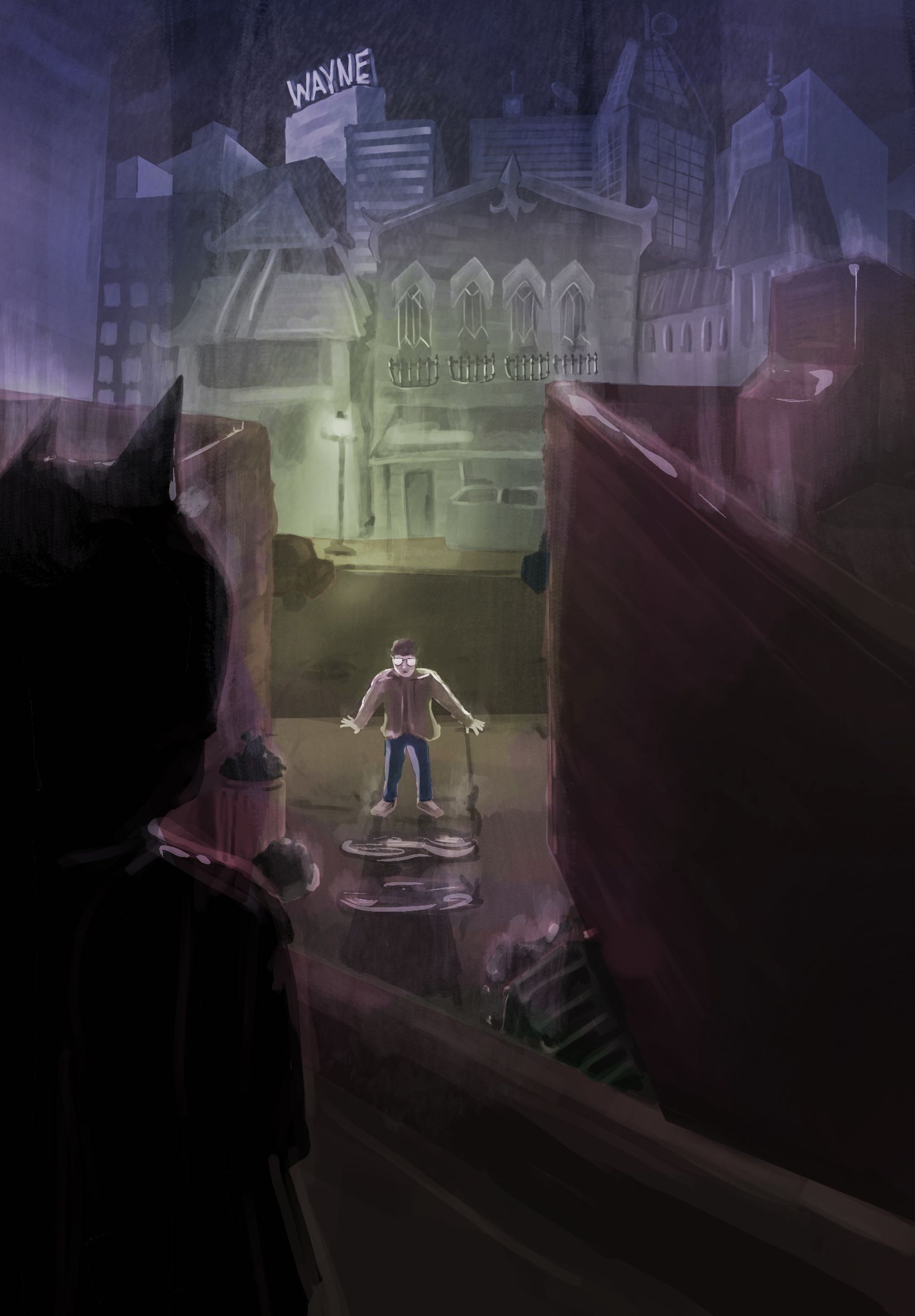
There was something else, too. The softest hush-hush rustle of fabric. The barest creak of muscle. And then, an exhale. A heartbeat that seemed, for a moment, to reverberate through the city itself, that broke her unbearable waiting, that filled her chest and brought her to waking…
Clark opened his eyes, staring up into the darkness.
There was nothing there. But a moment ago, there had been. And, whatever it was, it had been watching him.
"You're real," he whispered to the night.