
Chapter Text
The Barbican Concert Hall had been closed for renovation so long that even the pigeons had stopped trying the boarded windows. Inside, the air tasted of cold concrete and old rosin, the scent of a building that had forgotten how to exhale.
Scaffolding still strangled the foyers; dust sheets lay over the seats like shrouds. Officially, the silence was absolute.
Julian Ashford knew better than most that silence can lie.
He came in through the stage door at a quarter to one, the hour when London pretends to sleep. The night porter lifted one eyebrow, pocketed the folded fifty Julian slipped him, as usual, and returned to his newspaper without a word. Julian moved through the corridors the way a man walks through a dream, quickly and quietly, afraid of what might speak back.
He did not switch on the house lights. Moonlight, thin and winter-pale, leaked through gaps in the high clerestory and laid silver bars across the empty stalls. The grand Steinway waited on stage beneath its grey cover, patient as a sleeping animal. Julian paused at the edge of the pit, coat collar turned up, hands deep in pockets, and listened.
For a moment, there was only the faint murmur of the city far away. Then a single note (G below middle C on the violin, bowed so slowly it seemed to draw blood from the air). The note rose, fractured into harmonics, settled into a melody Julian had never been taught yet felt he had waited his whole life to hear.
He walked down the centre aisle as though wading through water and took the same seat he had claimed for the past nineteen nights: front row, dead centre, close enough to see the dust motes dancing in the shaft of moonlight, far enough that the balcony above remained a cavern of perfect darkness.
The music unfolded like a confession. A slow, northern sarabande in E minor, every phrase shaped by a hand that understood grief the way other hands understand bread. Julian’s pulse slowed to match the tempo; the permanent ache behind his eyes loosened its grip. He shut them and let the sound pour through the cracks in him.
He no longer questioned whether he was imagining it. Some nights the violin gave way to the piano (low, bell-like chords that made the floor vibrate gently under his shoes). Other nights, the two instruments spoke to each other across the empty hall, trading phrases the way lovers trade glances across a crowded room. Always the same presence behind the notes: solitary, meticulous, impossibly tender.
On the twenty-third night, Julian brought a small parcel wrapped in midnight-blue paper and left it on the piano lid: a cake of dark rosin, the color of burnt honey. He stepped back, hands in coat pockets again, and waited.
The music began immediately, but differently (lighter, almost playful). A quicksilver Capriccio that danced along the edge of sorrow without falling in. Halfway through, it paused on an open fifth, fragile as frost.
From somewhere high in the blackness above the balcony came a voice (low, careful, the voice of someone unused to being heard).
“Will you stay until the end tonight?”
Julian’s breath caught. He looked up, eyes straining against the dark, able to see nothing but the faint glint of moonlight on a string.
“Yes,” he said, the word barely louder than the silence that had owned the hall for years. “I’ll stay.”
The open fifth resolved into a chord so radiant it felt like sunrise inside his ribcage. The Capriccio resumed, faster now, reckless, exultant, until the final note hung in the air like a held breath.
When it faded, Julian remained seated long after the echo died. He did not move until the first grey of morning began to dilute the moonlight. Only then did he stand, walk to the piano, and touch the lid where the rosin had been.
In its place lay a single white rose, fresh, impossible, its petals still cool with night.
The rose stayed in Julian’s coat pocket for three days; he could not bear to leave it anywhere it might wilt.
On the fourth night, he brought another gift: a thin silver chain with a tuning fork on the end. He laid it beside the piano’s music desk and waited.
The violin answered almost at once, but this time it was too close. The sound came from the stage itself, not the balcony. Julian’s heart lurched; he stood slowly, afraid a sudden movement would frighten the musician away.
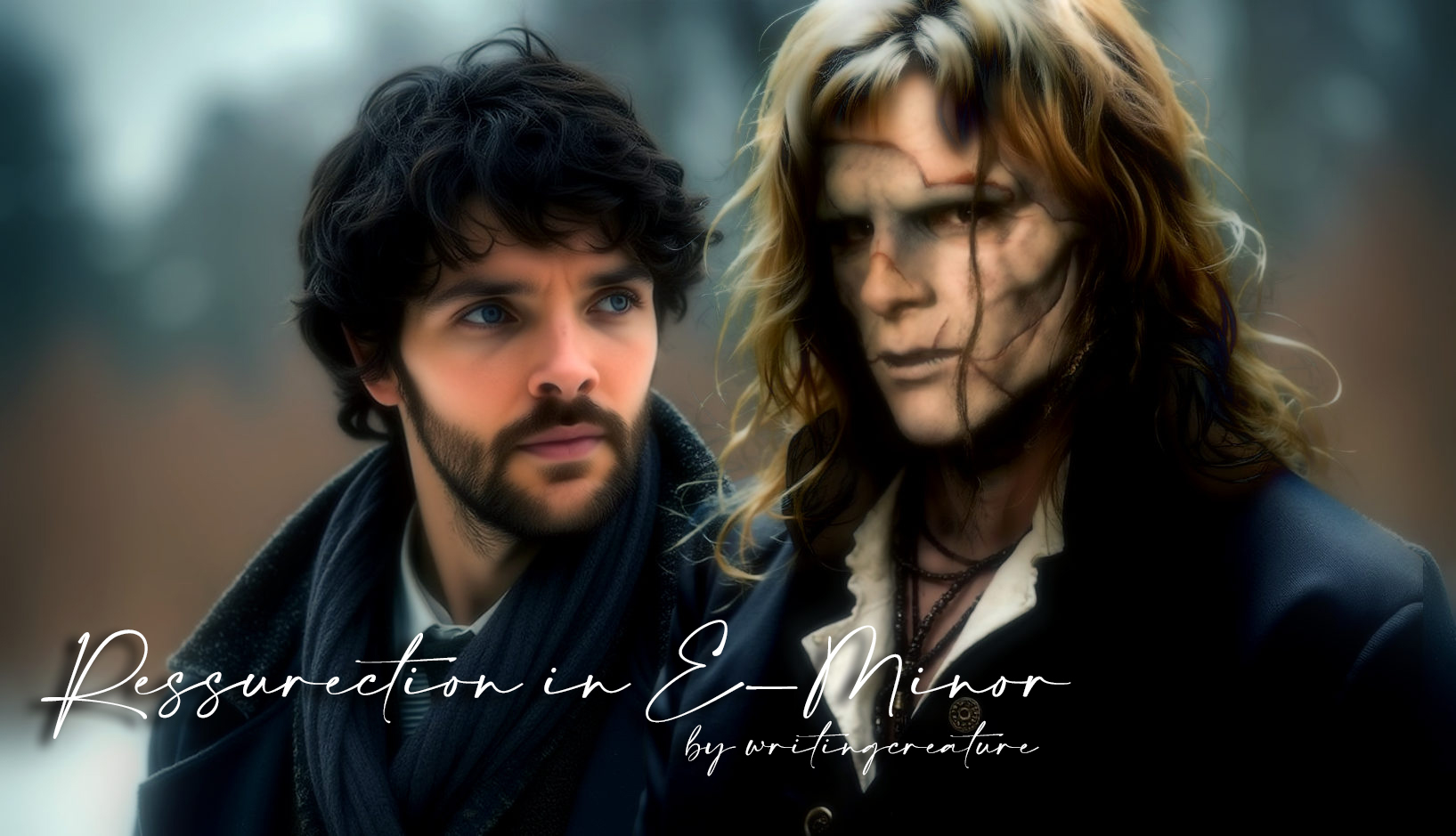
A figure stood in the shaft of moonlight beside the Steinway: impossibly tall, shoulders draped in a frock coat the color of midnight, cut in an old-fashioned swallow-tail that reached almost to the backs of his knees. The cuffs and collar were frayed velvet, once black, now faded to charcoal. A waistcoat of deep wine brocade caught what little light there was. His hair (long, uneven, the shades of ash and winter wheat and candle-smoke) fell past his shoulders in untamed waves, half-hiding his face.
He held the violin against his chest like a shield. The bow trembled, just once.
Julian took one involuntary step forward and stopped. The man flinched, a full-body ripple, as though the floor itself had burned him.
“I’m sorry,” Julian whispered. “I didn’t mean to startle you.”
Elia’s head lifted a fraction. Moonlight slid across the side of his face: skin pale as parchment, a seam running from temple to jaw like a crack in porcelain, another disappearing beneath the collar. His eyes were dark, too large, and unbearably gentle.
“You came back,” Elia said. The words arrived slowly, carefully spaced, as if he had rehearsed them for decades and still feared they might break on the air.
“Every night,” Julian answered. His voice cracked on the second word. “I couldn’t stay away.”
A pause. Then Elia lifted the bow again and drew a single note (soft, searching). Julian felt it in his sternum. Elia played a phrase; Julian, without thinking, hummed the answering phrase he heard in his head. Elia’s bow stopped mid-stroke. He stared at Julian as though the conductor had just spoken fluent starlight.
“You hear it too,” Elia breathed.
“I always have,” Julian said. “I thought I was going mad.”
Elia’s mouth curved, not quite a smile, something smaller and more precious. He stepped forward, hesitant, until only the width of the piano separated them. Up close, Julian could see the careful stitches across the backs of his hands, the way the cuffs had been lengthened many times with mismatched velvet. He could smell rosin, cedar, and very old wool.
Julian reached out, slowly, giving every chance to retreat, and touched the tuning fork that still lay on the music desk. He struck it gently against the wood. The pure A shimmered between them.
Elia’s eyes filled with actual tears, bright and impossible. He lifted the violin once more and played the same A, perfectly in tune with the fork, sustaining it until the metal’s ring and the string’s voice became one trembling sound.
Julian’s throat closed. He had conducted the greatest orchestras in the world, but nothing had ever felt like this: two hundred years of loneliness answering one ordinary man’s sleepless nights.
Elia lowered the violin. The movement shifted his hair; for the first time, the moonlight found his whole face. Julian saw the rest of the scars, the slight asymmetry of the lightning left behind, the sorrow carved so deep it had become beauty. He saw and felt no horror. Only a rush of tenderness so violent it frightened him.
“You’re real,” Julian said, voice raw. “You’re real, and you’re… God, you’re beautiful.”
Elia made a slight choked sound and took half a step back, bow clattering softly against the piano lid. His free hand rose as if to hide his face, then fell again, trembling.
“I am not—” he began.
“You are,” Julian cut in fiercely, stepping around the piano until barely a foot remained between them. “I don’t know your name or how long you’ve been here or why you hide, and I don’t care. I have never heard anyone play as you do. I have never felt anyone play the way you play. I—” He stopped, laughed once, a broken sound. “I think I’ve been looking for you my entire life, and I didn’t know it until three weeks ago.”
Elia stared at him, tears sliding silently down the stitched cheek. His lips parted, but no words came.
Julian reached out again (slow, deliberate) and let his fingertips rest, feather-light, against the frayed velvet at Elia’s wrist. The taller man froze, but did not pull away.
“My name is Julian,” he said quietly. “And I’m not going anywhere."
For a long moment, the hall held its breath with them. Then Elia turned his hand, very carefully, until Julian’s fingers lay against cool, scarred skin instead of cloth. He closed his eyes.
“Elia,” he whispered, as though giving a secret to the moonlight itself. “My name… is Elia.”
Julian’s heart turned over. He curled his fingers gently, cradling the broken hand as if it were made of glass.
“Hello, Elia,” he said, the man who had everything the world called success, and nothing that mattered. “I’m so glad I found you.”
Above them, the silent hall kept their names safe, and the white rose in Julian’s pocket pressed its fragrance against his heart like a promise neither of them was ready to speak aloud, not yet.